
An AI website builder can generate a polished starting point from a prompt, while custom development can shape the site around your sales process, integrations, data, and growth plan. When comparing an AI website builder vs. custom development, the better choice depends on the job your website must perform over the next 12 to 24 months.
Here is the short answer: Choose an AI builder when speed, simplicity, and early validation matter most. Choose custom development when the website needs distinct workflows, deeper integrations, stronger technical control, or a foundation that can grow with the company.
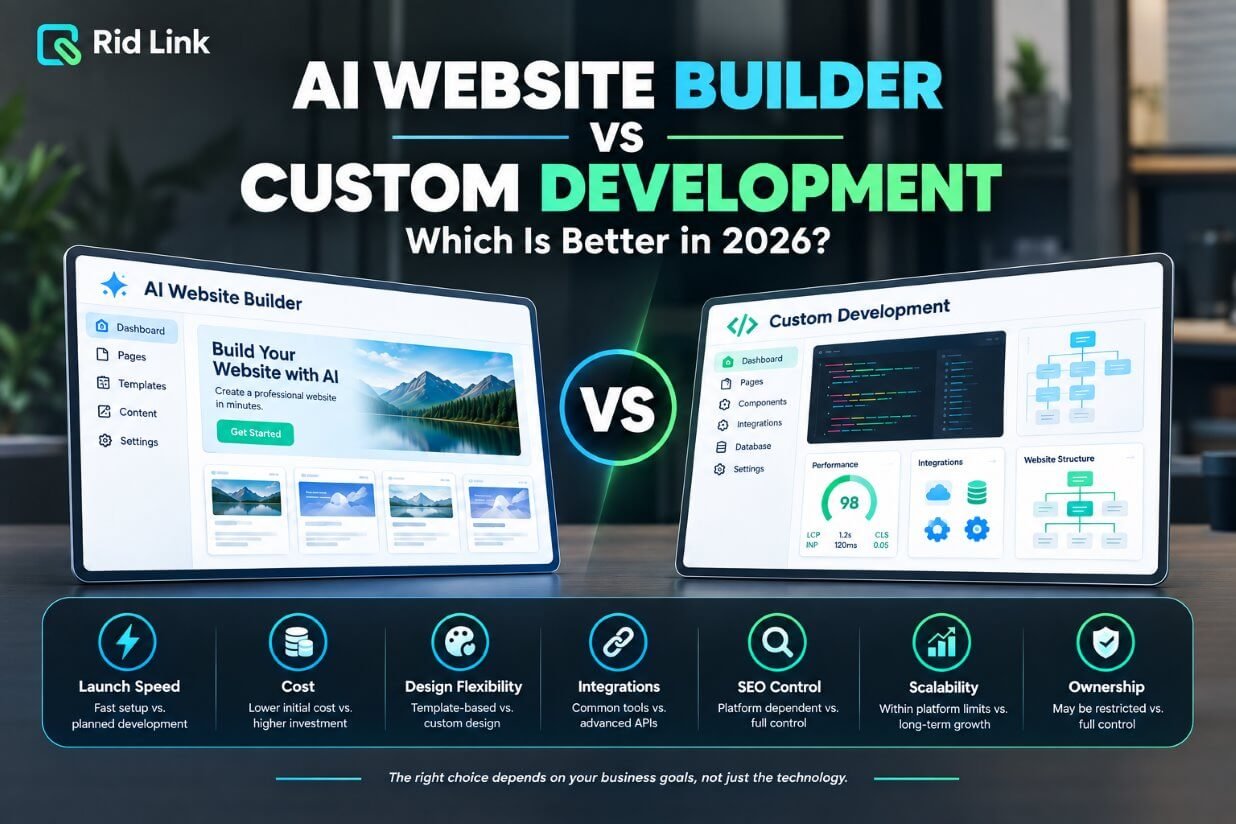
AI Website Builder vs Custom Development: Key Differences
An AI website builder is usually the better starting point for a simple marketing site, campaign page, portfolio, or early-stage business. Custom development is usually the better long-term choice for a growing B2B company with complex user journeys, CRM workflows, data requirements, or a conversion-critical website.
This is not a contest between “easy” and “professional.” Wix Studio, Squarespace AI, and Framer can all help teams launch quickly. Custom work can also fail if the strategy, content, testing, or performance plan is weak. The important comparison is control versus convenience.
| Area | AI Website Builder | Custom Development |
| Launch | Fast for standard pages | More time for strategy, design, build, and testing |
| Cost | Lower starting subscription | Higher upfront investment |
| Design | Uses platform templates and components | Built around the brand and customer journey |
| SEO control | Depends on platform settings | Greater control over structure and technical performance |
| Integrations | Best for common tools and forms | Better for CRM workflows, APIs, dashboards, and private systems |
| Scalability | Works within platform limits | Designed for unusual or expanding requirements |
| Best for | Prototypes, simple sites, and early validation | Growing businesses and complex digital operations |
When an AI Website Builder vs. Custom Development Choice Favors Builders
An AI builder is useful when the main risk is delay. A founder may need a credible service site, a new landing page, or a local business presence without waiting for a long design and development cycle.
Wix Studio can suit teams that want visual control within a hosted platform. Squarespace AI can help with guided site creation and content starting points. Framer is often considered by design-led teams that want fast visual iteration and hosted publishing. These are examples, not universal recommendations; plan features and prices change, so check each provider before committing.
An AI website builder is usually a sensible fit when the site has a clear, standard structure:
•a homepage and service pages;
•an about page and contact form;
•a small content library or blog; and
•common analytics, email, booking, or payment connections.
The speed is valuable because it gives a business time to test its offer and messaging. Still, generated output is not finished output: review headings, titles, redirects, forms, image sizes, accessibility, mobile layout, analytics, and privacy controls before publishing.
When custom development delivers more long-term value
Custom development becomes more attractive when the website is part of the operating model: a guided quote journey, CRM integration, private dashboard, role-based access, booking logic, or data exchange between systems.
The stack should match the requirement. React or Next.js can suit modern front ends, Headless WordPress can separate editorial control from presentation, Laravel can support business applications, and custom backend APIs can connect private workflows. The point is not fashion; it is maintainability, security, testing, and room to extend.
Core Web Vitals are part of the commercial experience.
Google describes Core Web Vitals as real-world measures of loading performance, responsiveness, and visual stability. Its current “good” targets are LCP within 2.5 seconds, INP below 200 milliseconds, and CLS below 0.1. These targets support a better user experience, but they are not a guarantee of first-page rankings.
An AI builder may deliver good performance when its templates, media, and scripts are well managed. It may also add features that a particular business does not need. A custom build offers more control over assets, images, code splitting, rendering, and third-party scripts, but performance must be included in the brief from the beginning.
Monitor real users with Google Search Console’s Core Web Vitals report, then investigate the pages that matter commercially. A fast homepage is useful; a fast service page, quote form, booking flow, and mobile conversion path may matter even more.

The strongest choice depends on the level of control the business needs after launch.
Cost and ROI: the part most comparisons simplify
Hosted AI builders often have a low entry price. A broad starting range of roughly $15–$50 per month is reasonable for many basic plans, but it is not a universal price. Billing cycle, country, taxes, domain registration, email, e-commerce, premium apps, AI credits, bandwidth, and extra seats can change the total. Official platform pages should be checked before purchase.
The hidden cost is often not the first subscription. It can be the paid app needed for a form, the upgrade required for multiple languages, the fee for advanced analytics, the cost of moving away from a locked ecosystem, or the time spent working around a platform limit.
Custom development usually requires a higher upfront investment because the business pays for research, information architecture, design, implementation, testing, deployment, and documentation. It does not mean zero recurring costs. Hosting, domains, monitoring, security updates, maintenance, support, and third-party services can still create ongoing expenses.
The practical ROI question is different: which option reduces business friction or creates more qualified opportunities? A custom workflow may justify its cost if it removes manual sales work, improves lead quality, connects data reliably, or makes a high-value customer journey easier to complete. An AI builder may deliver better ROI when it helps the team validate the offer before making a larger commitment.
SEO and AI search: platform choice is only one piece.
Search visibility does not come from a platform name alone. It comes from useful pages, clear entities, accurate claims, strong internal linking, accessible layouts, descriptive metadata, good performance, and content that answers real questions.
Google’s people-first guidance emphasizes original value, reliable information, expertise, clear sourcing, and a satisfying reader experience. It also warns against content produced mainly to attract search traffic without adding meaningful value.
For AI overviews, ChatGPT, and other answer systems, write concise answers that can stand alone, then explain the reasoning underneath. A definition such as “An AI website builder prioritizes speed; custom development prioritizes control and flexibility” is easier to understand and cite than a paragraph filled with vague marketing language.
Use Article, Organization, BreadcrumbList, and FAQPage structured data only when the page visibly supports it. Schema helps machines interpret content; it does not replace evidence, expertise, or a useful page.
Ownership, security, and migration questions to ask
Before signing up, ask whether you can export your content, control your domain, connect your current tools, access form data, create backups, and move the site later. Also ask how permissions work, where customer data is stored, how failures are handled, and who is responsible for updates.
A hosted builder can suit a brochure site; complex CRM, membership, reporting, or operational workflows may need a more controlled architecture. Rid Link can help assess those requirements before the budget is committed.

A reliable website decision starts with business requirements, not a trendy tool.
Which option should a growing B2B business choose?
Choose an AI website builder when the site is mainly informational, speed matters, common integrations are enough, and the team accepts the provider’s boundaries.
Choose custom development when the customer journey is unusual, integrations are central to sales or operations, accessibility and performance need close control, or the website is becoming a core business system.
A hybrid path can work well. Start with an AI builder to test the offer, then plan a custom migration when traffic, lead volume, or workflow complexity justifies it. Protect the future by planning URLs, content ownership, analytics, redirects, and data migration early.
Final Verdict: AI Website Builder vs Custom Development
The AI website builder vs custom development decision has no universal winner. An AI builder can shorten the distance between an idea and a live page. Custom development can create the control and flexibility a growing business needs when the website becomes part of sales, service, and operations.
Choose the simplest architecture that supports the next stage of the business. Measure qualified enquiries, completed tasks, search visibility, Core Web Vitals, and customer feedback, not just launch speed.
Not sure which architecture fits your 12-month roadmap? Get a technical website & architecture audit before committing your budget.
A focused audit can clarify platform limits, integration requirements, content ownership, performance risks, migration concerns, and the most sensible next step before a major build begins.
Frequently asked questions
Is an AI website builder good enough for a small business?
Often, yes, when the site has standard pages, ordinary forms, and modest integration needs. Review SEO, accessibility, speed, security, analytics, and content before launch.
Is custom website development automatically better for SEO?
No. Custom development offers more control, but rankings still depend on relevance, useful content, authority, technical quality, and user experience.
Do custom websites have no recurring costs?
No. Hosting, domains, maintenance, security, monitoring, support, and third-party services can still cost money.
Can a business migrate from an AI builder later?
Yes, but confirm content export, domain control, URL structure, redirects, media ownership, analytics, and data access first.
References
[1] Google Search Central: Understanding Core Web Vitals and Google search results
[2] Google Search Central: Creating Helpful, Reliable, People-First Content
[3] Wix Studio: Official Plans and Pricing